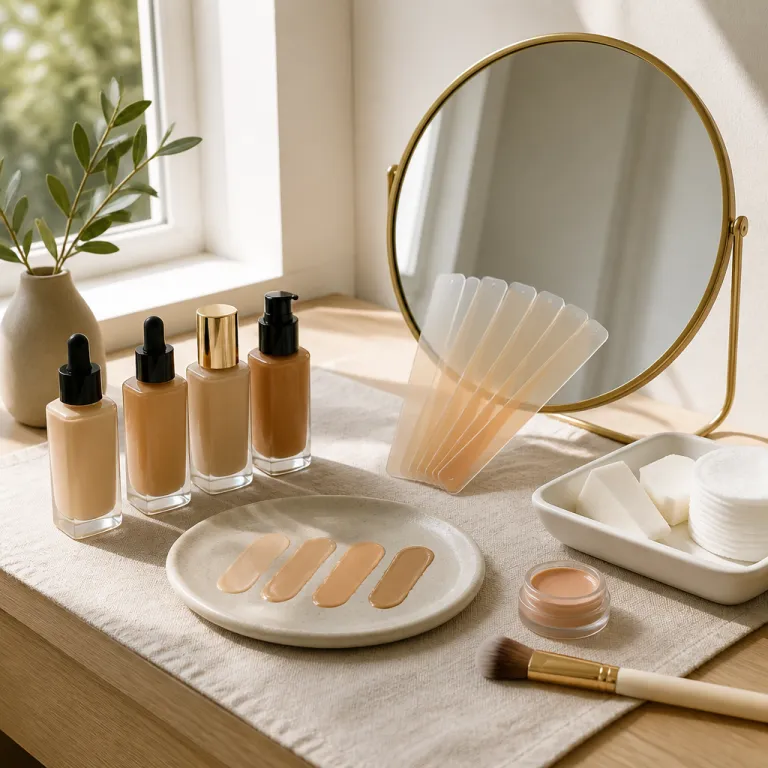
Why jawline swatching fails on real skin
A single swipe along the jaw looks efficient but rarely tells the truth. The skin on your jaw is often cooler and less exposed than the rest of your face, so that classic jaw swatch usually gives you a foundation shade that looks flawless in store and slightly off once you step into daylight. If you want to understand how to choose the right shade of foundation for luxury formulas, you need to treat your whole face as the canvas, not just the edge of the frame.
Most people have at least two visible skin tones on the face and neck, and the jaw sits at the intersection where shadows and natural contours distort color perception. That is why shade matching only on that strip often ignores the way your forehead catches more sun, your cheeks hold more redness, and your neck can be lighter than your face, which makes the wrong foundation look like a mask. A better method is to apply three stripes of foundation colors from cheek to face neck in natural light, then blend them slightly upward and downward to see which tone visually disappears into both areas.
Luxury makeup brands know this, which is why their artists rarely rely on a single icon arrow shaped swatch along the jaw when they try to find foundation for demanding clients. They usually test across the center of the face, near the nose and mouth, because this is where undertones, redness, and texture all meet and where the right foundation must perform under scrutiny. When you are alone without a counter expert, think like a pro and treat your cheek, nose, and upper neck as your private shade finder zone rather than trusting a quick jawline test.
Reading undertones in natural light, not store lighting
Getting undertones right is the quiet luxury move that makes even sheer makeup look expensive. To work out how to choose the right shade of foundation for your skin, start by standing near a window with indirect daylight and looking at your bare face, neck, and chest together rather than relying on the yellow store lights that flatten color. In this light, you can see whether your skin tone leans warm, cool, or more natural neutral, which guides every foundation match you make afterward.
Use three simple tests to decode your undertone before you even touch a bottle. First, the vein test on the underside of your wrist or inner arm ; greener veins usually signal a warm undertone, bluer or purpler veins suggest a cool undertone, and a mix points to a more natural neutral undertone that can wear both foundation colors families. Second, the white shirt test where a crisp white tee makes warm skin look golden and cool skin look rosy, and third, the metal test where gold jewelry flatters warm tones while silver tends to flatter cool tones more.
Once you know your undertones, you can filter every foundation shade range quickly, whether you are browsing a luxury oreal counter or scrolling an online shade finder tool. Look for naming cues like “warm”, “cool”, or “neutral” in the formula description, and remember that the perfect foundation for your skin type will usually echo your natural undertone rather than fight it. If you are planning a dramatic eye look later, such as a modern take on smoky kohl explained in this smoky kohl tutorial, a neutral tone base that respects your real skin color will keep the overall makeup broad look polished instead of theatrical.
Accounting for oxidation, wear, and broad spectrum protection
Even the most perfect foundation can betray you if it oxidizes two shades deeper by lunchtime. Oxidation happens when the pigments and oils in a foundation formula react with air, sebum, or skincare underneath, which can shift the color from fresh wear beige to an unwanted orange tone after an hour. When you are learning how to choose the right shade of foundation, you must test not only the initial match but also how the shade behaves on your skin over time.
Apply your top two candidates to opposite sides of your face, blend them over your usual skincare and any spectrum SPF you wear, then leave them for at least thirty minutes before judging. Some luxury bases, especially those with niacinamide or other active skincare ingredients, can look slightly lighter at first and then settle into the true foundation shade as they dry down, while others deepen as they mix with natural oils. This is why a quick swatch on the hand or jaw tells you almost nothing about how you will actually wear foundation during a full working day or an evening event.
Pay attention to labels that mention broad spectrum protection, because SPF filters can subtly affect foundation colors, especially in flash photography. A base with strong makeup broad spectrum SPF can bounce light back and make a too light shade look even more obvious in photos, so you may prefer to rely on a separate sunscreen and then choose the right foundation purely for color accuracy. For long days or outdoor events, test your chosen shade in daylight, office lighting, and under warm evening bulbs, and remember that a base that still looks like your own skin after eight hours is the real luxury icon of your routine, especially when paired with techniques like color melting described in this guide to color melting for hair.
Skin type, finish, and formula: why texture changes the shade
Two bottles with the same name can look like different foundation colors once they hit your skin. Your skin type, preferred finish, and chosen formula all influence how to choose the right shade of foundation, because coverage level and texture change how much of your natural tone shows through. A sheer skin tint on dry skin will let freckles and warmth peek through, while a full coverage powder foundation on oily skin can sit on top and read lighter or flatter.
If your skin is dry or mature, a hydrating liquid with a satin finish usually gives the most forgiving match, because the formula melts into the face and lets your natural undertones breathe through. For combination or oily skin types, a soft matte or natural matte finish can control shine, but you may need to go half a shade deeper than your exact skin tone to avoid looking chalky once oil mixes in and slightly lightens the visible color. When you wear foundation with very high coverage, remember that it erases more of your own pigment, so the right foundation in that category must be an almost exact match to your neck and chest rather than just your cheeks.
Luxury houses often offer parallel lines, such as a luminous liquid, a long wear foundation concealer hybrid, and a pressed powder foundation, all in supposedly the same shade. In practice, the liquid may appear more natural, the concealer version slightly denser and cooler, and the powder a touch warmer once buffed over the face neck area. Always test the specific formula you plan to wear foundation in, not just the name, and do not assume that your perfect foundation in a dewy finish will translate directly into the matte sister line without another careful shade matching session.
From counters to your bathroom: practical shade finder tactics
Luxury beauty lovers often shop online or through private sales, where there is no artist with a brush waiting to find foundation for you. To translate counter level expertise into your bathroom, start by shortlisting three possible shades based on your skin tone and undertone, then order samples or travel sizes whenever the brand allows it. Apply each candidate in vertical stripes from cheek to neck, blend lightly, and step away from the mirror for a few minutes before judging which foundation shade disappears into both face and neck.
Use your phone camera as a modern shade finder tool, but do it intelligently. Take one photo in indirect daylight, one under warm indoor lighting, and one with flash, then compare how each foundation match looks against your chest and shoulders, because the right foundation should harmonize with the entire upper body, not just the center of your face. If you see a clear line where the color stops at the jaw, the shade is wrong, but if the transition from face neck to décolleté looks seamless, you are close to your perfect foundation.
When browsing online, ignore the tiny icon arrow graphics and icon social buttons and head straight for swatch photos on real skin, ideally with your skin type and similar undertones. Look for brands that show multiple models per shade, and pay attention to how the formula sits on texture, pores, and fine lines, not just the color. For a deeper dive into how base products interact with the rest of your look, this analysis of the soft focus effect in cloud lip textures is a useful reminder that finish can change how we read color on the entire face.
When precision matters and when “close enough” is truly enough
Not every day demands a laboratory level shade matching session. For casual errands or a quick office day, a sheer formula that is within one tone of your skin can still look natural, especially if you keep the coverage light through the center of the face and let your real skin show at the edges. In these moments, how to choose the right shade of foundation is less about a perfect foundation match and more about finding a base that respects your undertones and fades gracefully.
Precision becomes non negotiable for photography, video, and events where lighting is harsh and long wear is essential. If you are wearing a long wear fresh wear style base with broad spectrum SPF under studio lights, even a half shade mismatch can read as grey, sallow, or overly warm on camera, which is why professional artists often mix two foundation colors to find perfect harmony between face, neck, and chest. For bridal looks, red carpet events, or important presentations, invest time in testing several shades over a full day, including flash photos, to ensure the right foundation stays true from morning to late evening.
Think of your base as the quiet icon of your makeup wardrobe, not the star but the frame that makes every other color look intentional. Whether you are reaching for a hybrid foundation concealer stick, a velvety powder foundation, or a luminous liquid formula, the goal is always the same ; to find foundation that looks like your skin on its best rested day. The real test is not the influencer swatch but the mirror test after eight hours, when the makeup broad strokes of your look still feel like you, not like a filter.
Key figures on foundation shade matching
- Studies published in the Journal of Cosmetic Dermatology report that more than 60 % of consumers describe their current foundation as a less than perfect shade match, which explains the rise of online shade finder tools and multi shade purchases.
- Research from L’Oréal’s beauty tech division shows that using multi angle facial imaging improves shade matching accuracy by up to 95 % compared with traditional single area swatching on the jaw alone.
- Consumer testing by several luxury brands has found that foundations with broad spectrum SPF can appear up to one half shade lighter under flash photography than identical formulas without SPF, which affects how professionals choose base products for events.
- Market data from prestige retailers indicates that customers with access to sample programs are around 30 % more likely to repurchase the same foundation shade, suggesting that real wear testing at home leads to more confident matches.
FAQ
How do I quickly figure out my undertone for foundation?
Stand in natural daylight and look at your veins, your reaction to a white shirt, and which metal jewelry flatters you most. Greener veins, a golden look in white, and preference for gold usually signal a warm undertone, while bluer veins, a rosy look in white, and preference for silver suggest a cool undertone. If you see a mix of both and can wear gold and silver comfortably, your undertone is likely more neutral, which gives you more flexibility when choosing a foundation shade.
Should my foundation match my face or my neck?
For the most seamless result, your foundation should visually connect your face and neck so there is no obvious line of demarcation. If your neck is much lighter than your face, aim for a shade between the two and blend down slightly so the transition looks intentional. Always check the match in natural light with your face, neck, and upper chest visible, because this is how others will see your makeup in real life.
Why does my foundation look orange after a few hours?
An orange shift usually means the formula is oxidizing as it mixes with air, sebum, or skincare underneath. This can happen more with long wear or matte formulas that contain certain pigments and oils, especially on oily or combination skin types. To reduce oxidation, use a compatible primer, blot excess oil during the day, and test a slightly lighter or more neutral shade to see if it stays closer to your natural skin tone over time.
Can I mix two foundations to get my perfect shade?
Mixing two foundations is a common professional technique and can be very effective when you sit between shades or your skin tone changes with the seasons. Choose formulas with similar finishes and wear times, then blend them on the back of your hand before applying so you can adjust the ratio gradually. Keep a lighter, more neutral option and a slightly deeper, warmer option in your routine, and you can customize your match throughout the year without replacing your entire base wardrobe.
Is it better to go lighter or darker if I am between shades?
For sheer or light coverage formulas, going half a shade lighter and adding warmth with bronzer usually looks more natural than a base that is too dark. For full coverage or long wear foundations, a slightly deeper but well blended shade often photographs better than a too light one that can look chalky or grey. When in doubt, test both options on your cheek to neck area, wear them for a few hours, and choose the one that disappears most convincingly into your overall skin tone.